Awais Imran
In this guide
Three Ways to Send Money Abroad — One Is 5x More Expensive
Quick answer: Based on our analysis of real quotes from 80+ providers, money transfer apps are the cheapest way to send money abroad in 2026, costing an average of $5–$15 per $1,000. Cash agents cost $40–$80, and banks cost $50–$120. The winner depends on your priorities — apps win on cost and speed, agents win for cash pickup in rural areas, and banks win for... very little. Here's the full breakdown.
Every time someone needs to send money abroad, they face the same three options: walk into a bank, visit a cash agent, or open an app on their phone. The price difference between these three methods is staggering.
We used real data from our comparison engine — which collects quotes from 80+ providers every 6 hours — to compare the true cost of each method. Here's what we found.
Method 1: Banks (Most Expensive)
Sending money through your bank feels safe and familiar. But it's consistently the most expensive option across every corridor we track.
How Banks Price Transfers
- Flat fee: $25–$50 per wire transfer (US), £5–£30 (UK), €10–€40 (EU)
- Exchange rate markup: 2–5% above the mid-market rate — this is the real cost
- Correspondent bank deductions: $15–$60 deducted in transit via SWIFT
- Receiving bank fee: $5–$25 at the destination
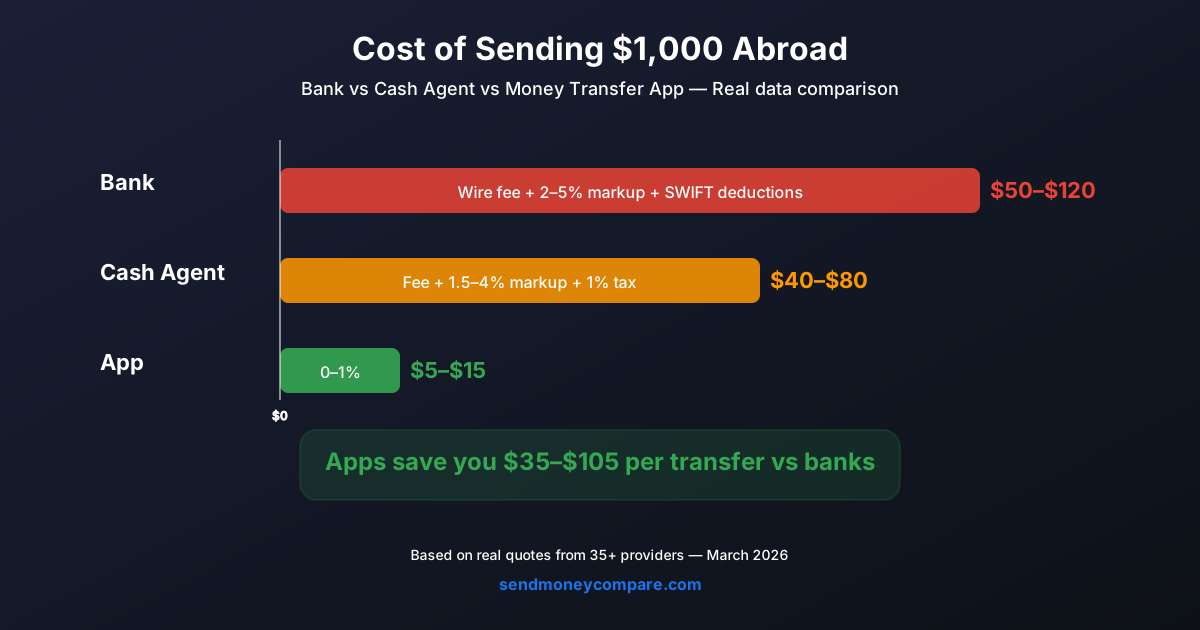
Total cost on a $1,000 transfer: $50–$120 (5–12%)
According to the World Bank, sending money through a bank costs an average of 12.1% globally — making it the single most expensive transfer method available. Read our hidden fees guide for a breakdown of every cost banks don't tell you about.
When Banks Make Sense
Almost never for personal transfers. Banks are reasonable only for very large transfers ($50,000+) where you can negotiate rates with a relationship manager, or when you specifically need a documented SWIFT wire for legal or compliance reasons.
Method 2: Cash Agents (Moderate Cost)
Cash agents — physical locations operated by providers like Western Union, MoneyGram, and Ria — are the traditional way to send money internationally. You walk in with cash and your recipient picks up cash at an agent in their country.
How Cash Agents Price Transfers
- Transfer fee: $5–$15 (varies by amount and corridor)
- Exchange rate markup: 1.5–4% — better than banks, but worse than apps
- No correspondent bank fees: Cash agents use their own networks, not SWIFT
- US remittance tax: A 1% excise tax now applies to cash-funded transfers from the US (digital funding is exempt)
Total cost on a $1,000 transfer: $40–$80 (4–8%)
When Cash Agents Make Sense
Cash agents are valuable when your recipient needs physical cash pickup — especially in rural areas without reliable banking or mobile money. They're also useful for senders who don't have a bank account or prefer paying with cash. See our comparison of Western Union vs MoneyGram for a head-to-head on the two biggest agent networks.
Method 3: Money Transfer Apps (Cheapest)
Digital-first providers like Wise, Remitly, Instarem, and TapTap Send have transformed international transfers. You send from your phone or computer, funded by bank account or card, and money arrives in the recipient's bank account or mobile wallet.
How Apps Price Transfers
- Transfer fee: $0–$7 (many offer zero fees)
- Exchange rate markup: 0–1% — dramatically lower than banks or agents
- No intermediary fees: Apps use local payment rails, not SWIFT
- No receiving fees: The amount shown at checkout is exactly what arrives
Total cost on a $1,000 transfer: $5–$15 (0.5–1.5%)
Cost Comparison: $1,000 USD to INR
| Method | Provider | Fee | FX Markup | Total Cost | Recipient Gets |
|---|---|---|---|---|---|
| Bank | Chase | $5.00 | 3.24% | $37.40 | ₹91,447 |
| Agent (online) | Western Union | $0.00 | 0.64% | $6.40 | ₹94,376 |
| App | Wise | $6.85 | 0% | $6.85 | ₹94,362 |
| App | Remitly | $0.00 | 0.32% | $3.20 | ₹94,680 |
Live quotes from our comparison engine as of 18 October 2026; total cost is the fee plus the exchange-rate markup on $1,000. Western Union's row is its online bank-deposit price — walk-in cash pricing at agent counters is not published as a quote and is typically far higher. Rates move — check current USD to INR rates.
Side-by-Side: All Three Methods Compared
Bank vs App vs Agent: Feature Comparison
| Feature | Bank Wire | Cash Agent | Transfer App |
|---|---|---|---|
| Average cost ($1,000) | $50–$120 | $40–$80 | $5–$15 |
| Speed | 3–5 business days | Minutes (cash) to 1 day | Minutes to 1 day |
| Delivery options | Bank account only | Cash pickup, bank, mobile wallet | Bank account, mobile wallet |
| Requires bank account? | Yes (both sides) | No | Sender only |
| Exchange rate | 2–5% markup | 1.5–4% markup | 0–1% markup |
| Transparency | Low (hidden fees) | Medium | High (upfront pricing) |
| Best for | Very large transfers | Cash pickup, rural areas | Most transfers |
Which Method Should You Use?
For the vast majority of international transfers in 2026, a money transfer app is the right choice. The cost savings are dramatic — you'll save $30–$100 per transfer compared to a bank, and $20–$60 compared to a cash agent.
Choose a cash agent if your recipient needs to collect physical cash, especially in a rural area without bank access. Western Union has 500,000+ agent locations worldwide, and Ria offers competitive rates for cash pickup in Latin America and Asia.
Avoid your bank unless you're sending very large amounts or specifically need a documented SWIFT transfer. Even for large transfers, providers like OFX and TorFX specialise in high-value transfers with no fees and competitive rates.
Use our comparison tool to find the cheapest provider for your specific transfer. For a deep dive into the best apps, read our best money transfer apps 2026 guide.
Bank, App or Cash Agent: sources and method
Cost data is based on real quotes collected from provider APIs and websites every 6 hours via our automated scraping system. Bank fee ranges are from published fee schedules of Chase, Bank of America, HSBC, Barclays, and Commonwealth Bank as of March 2026. Global averages from the World Bank Remittance Prices Worldwide database.
Bank, App or Cash Agent: questions answered
Is it cheaper to use a bank or an app to send money abroad?
Why are money transfer apps cheaper than banks?
When should I use a cash agent like Western Union?
About the author