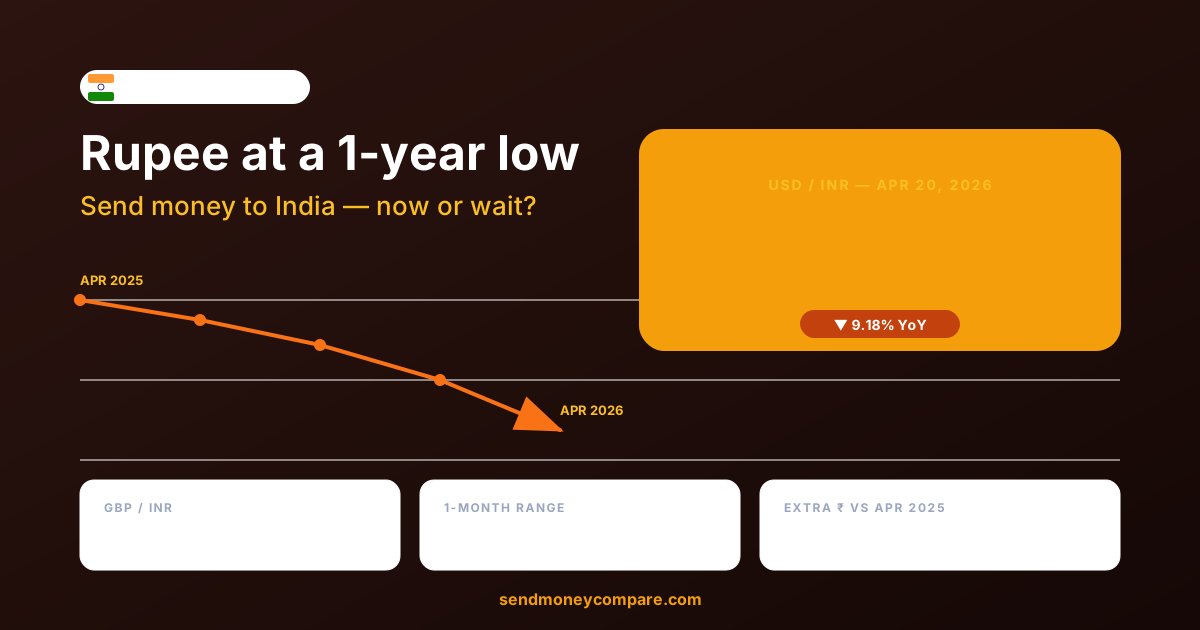
INR at 92.98/USD (April 2026): Should You Send Money to India Now or Wait?
The rupee is 9.18% weaker than a year ago at ₹92.98/USD, with the RBI actively intervening in FX markets. Here's a decision framework for when to send USD/INR and GBP/INR transfers — and how much timing really matters.
TL;DR — The Indian rupee is trading at ₹92.98 per USD on April 20, 2026 — its weakest level in a year and down 9.18% year-on-year. GBP/INR sits near 126. The Reserve Bank of India (RBI) is actively intervening to cap volatility, and Western senders are arguably in the strongest position of 2026 so far. Below: whether to send now or wait, how big the provider spread is, and why "waiting for a better rate" usually costs more than it saves.
Where the rate is today
| Pair | Rate (Apr 20, 2026) | 1-month range | 12-month change |
|---|---|---|---|
| USD / INR | 92.98 | 92.41 – 94.62 | INR down 9.18% |
| GBP / INR | 126.04 | 123.60 – 130.24 | GBP up ~8% |
| EUR / INR | ~101 | ~99 – 103 | EUR up ~6% |
In plain English: if you're sending USD, GBP, or EUR to India, your recipient is getting substantially more rupees than they would have a year ago. On a $1,000 transfer, that's roughly ₹7,800 more than April 2025 — enough to cover a month of groceries for a middle-class Indian household.
What's driving the weakness
Three forces are pushing the rupee down, each with different longevity:
- Dollar strength — The Fed's hold at 3.5% with one cut projected for 2026 keeps real US yields elevated. Every emerging-market currency has felt this.
- Oil imports — India imports ~85% of its crude. Every spike in Brent tightens INR further as state oil companies buy dollars. The RBI is now routing state-run oil importer demand through a special credit facility to reduce open-market pressure — a sign the weakness was getting structural.
- Offshore hedging pressure — The RBI has tightened FX position limits for banks and restricted offshore-linked hedging activity. This has helped: foreign investors turned net buyers of Indian equities (~₹3.8 billion inflow) in April, and the rupee has stabilised from its 94.62 low on April 13 to 92.98 today.
For the underlying macro calendar, see our April 2026 central bank calendar (Fed minutes April 9, ECB April 17 — both already priced in).
Send now or wait? The decision framework
There's a simple way to think about this. Your total transfer cost is:
Provider fee + provider FX markup + (timing risk × transfer size)
Fees and markup are knowable today. Timing risk is what you're guessing at.
Rule 1 — Pick the provider first, the timing second
The gap between the cheapest and most expensive provider on USD/INR is typically 0.5% to 3% of your transfer amount. The gap between today's rate and next week's rate is typically 0.3% to 1%. Switching from your bank to Wise, Remitly, or Instarem saves you more on almost any given day than waiting would.
See USA to India live rates or UK to India live rates for the provider-by-provider picture right now.
Rule 2 — If you must time it, watch the RBI
The RBI is clearly targeting stability, not direction. That means:
- Spikes above 94 have been met with intervention → likely to retrace toward 92–93 within days.
- Dips below 92 are possible but short-lived — the RBI's defensive posture is against weakness, not strength.
- Big-event days (Fed meetings, RBI meetings, Budget announcements) see wider intraday ranges — avoid transferring during the announcement, send 24–48 hours after.
Rule 3 — Use rate alerts instead of checking manually
Every major provider now offers rate alerts. Set a target that's 0.5–1% above today's rate, and you'll either hit it or learn that you overestimated the upside. Wise, Xe, and Revolut all have free alert features; our currency converter also shows the 30-day historical range so you can calibrate your target.
How much does a 1% rate move actually matter?
Put numbers on it. On a $5,000 transfer via Wise:
| Scenario | USD/INR rate | INR delivered | Difference |
|---|---|---|---|
| Today (Apr 20) | 92.98 | ₹464,900 | — |
| +1% rupee weakening | 93.91 | ₹469,550 | +₹4,650 |
| +1% rupee strengthening | 92.05 | ₹460,250 | −₹4,650 |
₹4,650 is meaningful, but it's also smaller than the typical ₹8,000–15,000 gap between the cheapest and most expensive provider on the same day. Provider choice > timing.
When timing really does matter — large transfers
If you're sending more than £25,000 / $30,000 — a down payment, NRI remittance, property purchase, or business payment — the calculus flips. A 1% rate move is $300+, and specialist FX brokers with forward contracts start to beat app-based providers.
For transfers that size, see our guides on B2B international payments and OFX / Currencies Direct — both offer forward contracts that let you lock today's rate for up to 12 months.
Live rates and tools
- USD to INR — live rate + history
- GBP to INR — live rate + history
- USA → India provider comparison
- UK → India provider comparison
- All corridors into India
- Complete India guide — UPI, IMPS, NEFT, banks, KYC
- India IBAN / IFSC lookup
Frequently asked questions
Why is the Indian rupee so weak in April 2026?
Three forces: sustained US dollar strength after the Fed's March hold, persistent oil import demand, and offshore hedging pressure. The RBI is intervening to stabilise — not reverse — the move, which is why the rate has stayed in a 92.4–94.6 range through the month.
Should I send money to India now or wait for a better rate?
For most senders, now is fine. Provider choice saves more than timing: the cheapest USD/INR provider typically delivers 1–3% more rupees than the most expensive on the same day, versus a 0.3–1% typical weekly rate swing. If you're sending over $30,000, consider a forward contract via OFX or Currencies Direct.
What's the best app to send USD to INR in 2026?
On the USA→India corridor, Wise, Remitly, and Instarem consistently lead on total INR delivered. Wise uses the mid-market rate with a fee of ~0.4–0.6%. Remitly's Economy tier is often the cheapest; Express is fastest. Instarem offers competitive rates with zero fees for first transfers.
How much has the rupee fallen against the dollar in the past year?
INR is down 9.18% against USD in the 12 months to April 20, 2026, trading at ₹92.98 versus roughly ₹85 a year ago. For a $1,000 transfer, that's ~₹7,800 more rupees delivered than last April.
For broader context on how currency moves interact with fees, see our guide on exchange rate markups. For the global picture, the 2026 global remittance trends report has the long-term data.