Wise Nasdaq Dual-Listing (May 2026): What It Means
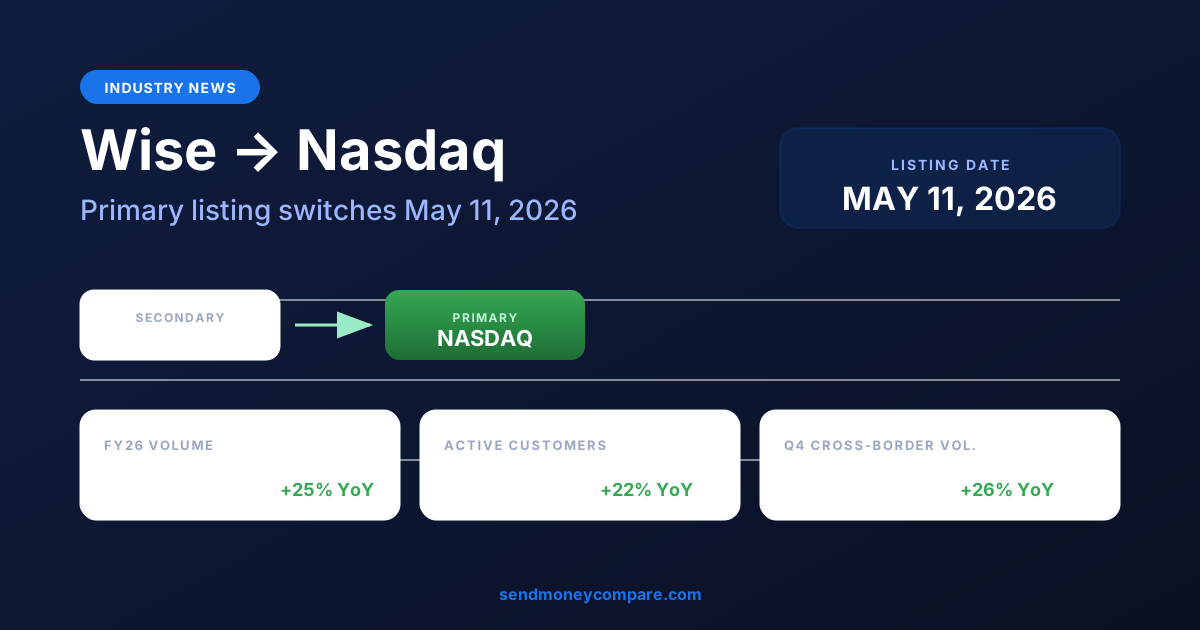
TL;DR — Wise switches its primary listing from the London Stock Exchange to the Nasdaq on May 11, 2026, with the UK keeping a secondary listing. The move follows a year in which Wise moved £181.7 billion across borders for 18.9 million active customers — cross-border volume up 26% year-on-year in Q4 FY26. Nothing changes for senders today: the same platform, the same tax-exempt digital funding, the same mid-market rate pricing. But the US capital base is the clearest signal yet that Wise intends to win the American corridor market at scale.
The numbers behind the move
Wise disclosed its full-year FY26 trading update alongside the listing date. The Q4 highlights are striking for a company that only IPO'd in 2021:
| Metric | Q4 FY26 | YoY change |
|---|---|---|
| Cross-border volume | £49.4 billion | +26% |
| Active customers | 11.3 million (quarter) | +22% |
| Underlying income | £435.3 million | +24% |
| FY26 total volume | £181.7 billion | +25% |
| Customer balances | £22.6 billion | +33% |
Why list on the Nasdaq — and why now?
Three reasons dominate the case for Wise's move.
1. Valuation multiples. Fintech peers trading on the Nasdaq — including SoFi and PayPal — have tended to command higher revenue multiples than UK-listed fintech. For a company growing cross-border volume at 25%+ a year, the re-rating alone could add several billion pounds of market capitalisation.
2. Dollar-denominated capital. A US listing gives the company a deeper pool of dollar capital to fund US bank partnerships, compliance infrastructure, and FedNow / CHIPS integration — the plumbing that makes USA-to-India, USA-to-Mexico, and USA-to-Philippines transfers settle in minutes rather than days.
3. Competitive pressure from Revolut. Revolut reported record 2025 revenue of £4.5 billion (€5.2 billion) and a full UK banking licence, and analysts at Citi have cited Revolut's accelerating cross-border expansion as a direct threat to Wise's UK base — which still generates roughly 20–25% of revenue. A Nasdaq platform gives Wise the balance sheet to defend and extend.
What changes for you as a sender?
Short answer: nothing, immediately. The Wise app, rates, fees, and product surface are unaffected by where the holding company trades its shares.
What changes over 12–24 months is where Wise invests. Three areas to watch:
- USD rails — Expect deeper integration with FedNow and US bank-held accounts, which will tighten USD-funded corridor settlement from hours to seconds. See our coverage of FedNow's cross-border push.
- New currencies — Watch Latin America and Africa, where routes such as GBP-to-NGN have high diaspora demand.
- Business banking — Wise Business is the fastest-growing segment. A US listing signals a push to compete directly with B2B platforms such as Airwallex and Payoneer.
Wise vs Revolut: the Nasdaq race
With Wise on the Nasdaq and Revolut holding a full UK banking licence and reporting £1.7 billion profit before tax on £4.5 billion revenue in 2025, the duopoly at the top of the retail FX market is tightening. For senders, this is good news — both firms compete almost entirely on price and speed.
If you're deciding between them, our Wise vs Revolut head-to-head compares fees, rates, corridor coverage, and speed for the most common routes. For USD-heavy senders, Wise vs PayPal and Wise vs Xoom are the comparisons that typically matter more.
Is Wise safe? Regulatory protection holds either way
A listing switch does not change Wise's regulatory status. Wise remains authorised by the FCA in the UK as an Electronic Money Institution, by FinCEN in the US as a Money Services Business, and by the ASIC, MAS, and RBI equivalents in its other regions. Customer balances are safeguarded — held separately from Wise's corporate funds in partner banks and government bonds, not deposited with Wise itself.
The UK's new FCA safeguarding rules taking effect May 7, 2026 strengthen this further: daily reconciliation, annual audits, and formal wind-down plans become mandatory for every FCA-regulated provider — including Wise and Revolut.
What to watch on and after May 11
- May 11, 2026 — Primary listing moves to Nasdaq under ticker WSE (WISE remains the LSE ticker). LSE keeps a secondary listing.
- Full-year FY2026 results (June 25, 2026) — First results as a Nasdaq-primary company.
- Q1 FY27 trading update (July 2026) — First quarterly update after the listing; watch for US volume growth as the headline metric.
- Half-year results (November 2026) — Expect a sharpened US corridor roadmap and likely new product announcements.
Questions about Wise's Nasdaq listing
Is Wise safe after the Nasdaq listing in 2026?
Yes. Wise's safeguarding and regulatory status is unchanged by the listing switch. Customer funds remain ring-fenced from corporate funds under FCA and FinCEN rules. The Nasdaq move is a corporate-governance change, not an operational one. See our full Wise review for the latest safety breakdown.
Will Wise fees or exchange rates change after May 11, 2026?
No. Wise's pricing is driven by its cost base and competition, not by where its shares are listed. The company's stated aim of continuing to lower its prices is unchanged.
Can I buy Wise shares if I'm a customer?
Yes. Wise has announced that existing shareholders will receive equivalent Nasdaq-listed shares on the listing date, and retail investors will be able to buy through any broker with Nasdaq access. This article is not investment advice.
Does Wise still serve UK customers after the move?
Yes. Wise retains a secondary LSE listing and its UK entity (Wise Payments Limited) remains FCA-regulated. UK senders see no change. Compare UK corridors: UK to India, UK to Pakistan, UK to Philippines.
For the broader competitive picture, see our 2026 global remittance trends report and the live comparison tool that shows exactly how Wise's rate stacks up against Remitly, Xoom, OFX and the rest on your specific corridor.