Send Money to Nigeria: New CBN Naira-Only Rule Changes Everything (March 2026)
From May 1, all remittances to Nigeria must settle in naira — no more dollar payouts. Compare how Wise, Remitly, WorldRemit and Western Union are adapting, and what diaspora senders should do before the deadline.
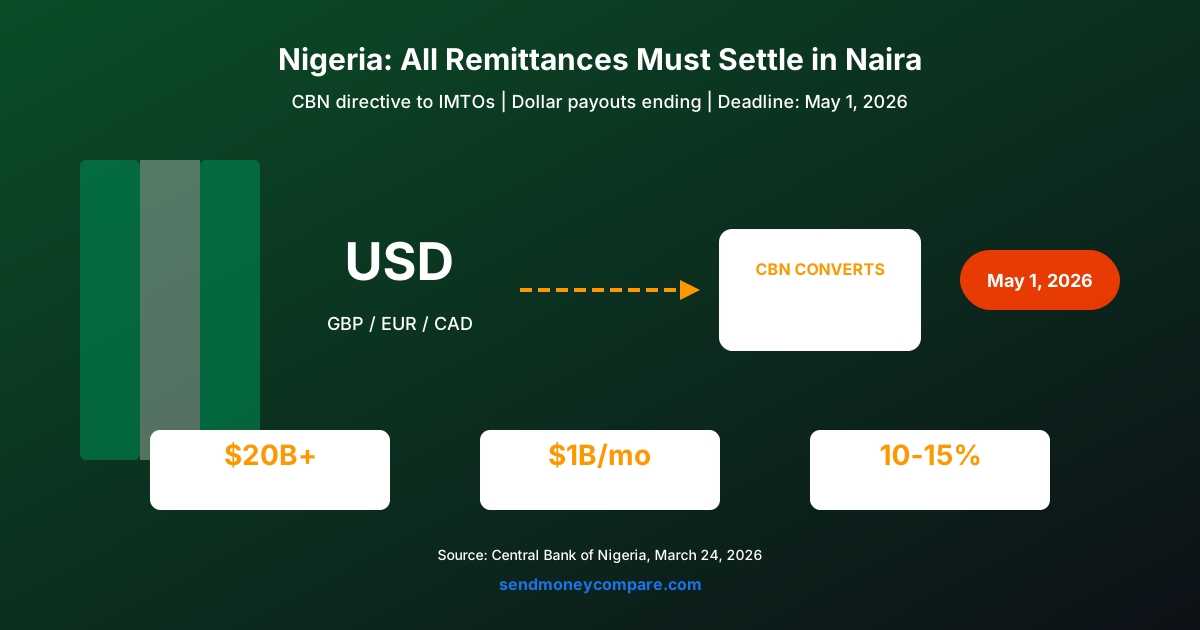
On March 24, 2026, the Central Bank of Nigeria dropped a directive that will reshape how millions of diaspora Nigerians send money home: all International Money Transfer Operators (IMTOs) must open naira settlement accounts with authorised dealer banks by May 1, 2026. From that date, recipients will receive naira — not dollars — when money arrives from abroad.
This is a seismic shift. For decades, many Nigerians receiving remittances from the US, UK, Canada, and Europe have received dollars (or pounds, or euros), often converting them at parallel market rates that were significantly more favourable than the official CBN rate. That era is ending.
Our take: bold reform with real risks
The CBN's stated goals are reasonable: channel more foreign exchange through the formal banking system, improve transparency, and stabilise the naira. Nigeria received an estimated $20 billion in remittances in 2025, making it Africa's largest remittance market. Capturing even a fraction more of that through official channels would boost FX reserves and support the naira.
But the execution carries real risks for ordinary senders and recipients:
- Conversion rate uncertainty — If IMTOs are forced to convert at the official CBN rate rather than the market rate, recipients could receive 10–15% less naira per dollar. The gap between official and parallel rates has narrowed under recent reforms, but it hasn't closed entirely.
- Compliance costs passed to senders — IMTOs face new banking requirements, reporting obligations, and settlement infrastructure costs. As TechNext24 reported, if operators absorb these costs, margins shrink and some smaller players may exit the market. If they pass costs downstream, fees go up.
- Informal channels could grow — When formal remittance costs rise, some senders shift to informal hawala-style networks or crypto. That undermines the very transparency the CBN is trying to achieve.
Which providers are affected?
Every provider that operates in Nigeria will need to comply. WorldRemit, Remitly, Western Union, and Wise all serve Nigerian corridors and will need to adapt their settlement infrastructure by May 1.
Providers that already settle primarily in naira — like some of the newer fintech operators — may have a smoother transition. Those that offered dollar payouts as a competitive advantage will need to rethink their value proposition for the Nigeria corridor.
What senders should do now
If you regularly send money to Nigeria, here's our advice:
- Send before May 1 if you want dollar payout — The deadline is tight. If your recipient prefers to receive USD, the window is closing.
- Compare rates aggressively after May 1 — Once all providers settle in naira, the differentiator will be which provider offers the best NGN conversion rate. Use our USA to Nigeria, UK to Nigeria, or Canada to Nigeria comparison tools to see real-time rates.
- Watch for fee increases — If compliance costs hit providers, they'll pass them on. Monitor your usual provider's pricing over the next 2–3 months.
- Consider multi-currency accounts — If your recipient has access to a domiciliary account or a service like Wise that holds multiple currencies, they may be able to receive and convert on their own terms.
UK to Nigeria: what changes for British senders
The UK-to-Nigeria corridor is one of the largest in Africa, with British Nigerians sending an estimated £3–4 billion annually according to World Bank remittance data. The new CBN rule hits this corridor especially hard because many UK senders specifically chose providers offering GBP-to-USD or direct dollar payout — giving recipients a hedge against naira depreciation.
Under the new framework, that hedge disappears. Every GBP transfer will be converted to naira at the official rate before reaching the recipient. For UK senders comparing the best way to send money from the UK to Nigeria, the key metric shifts from "which provider gives the best dollar rate" to "which provider gives the best naira rate" — and those rankings may look very different after May 1.
Providers like Wise that already use the mid-market rate with transparent markups may fare better than those whose pricing relied on opaque FX spreads. WorldRemit and Remitly, which both serve the UK-Nigeria corridor with competitive GBP/NGN rates, will need to renegotiate their settlement arrangements with Nigerian banks.
The bigger picture
The CBN says it's targeting $1 billion in monthly diaspora remittances by end of 2026, as reported by Zawya (that article is no longer reachable at its original URL; the CBN publishes its own statements and directives in its circulars). That's ambitious — and whether it happens depends entirely on whether the new rules make formal channels more attractive or simply more expensive. For a broader perspective on how African remittance corridors are evolving, see our guide to sending money to Nigeria and our 2026 global remittance trends report.
Frequently asked questions
Will I still receive dollars in Nigeria after May 2026?
No. From May 1, 2026, all IMTO inflows must be converted to naira through authorised dealer banks before reaching recipients. Dollar, pound, and euro payouts through formal remittance channels are ending.
How does the CBN naira-only rule affect Wise and Western Union?
Both must open naira settlement accounts with Nigerian banks by the May 1 deadline. Wise already uses the mid-market rate, so its conversion may be more transparent. Western Union has cash pickup networks across Nigeria that will now pay out in naira only.
What is the cheapest way to send money to Nigeria from the UK after May 2026?
Once all providers settle in naira, compare the total received amount (after fees and FX conversion) rather than the exchange rate alone. Use our UK to Nigeria comparison tool for live rates across 10+ providers.