1% US Remittance Tax Update: Cash Senders Switching to Digital Faster Than Expected (March 2026)
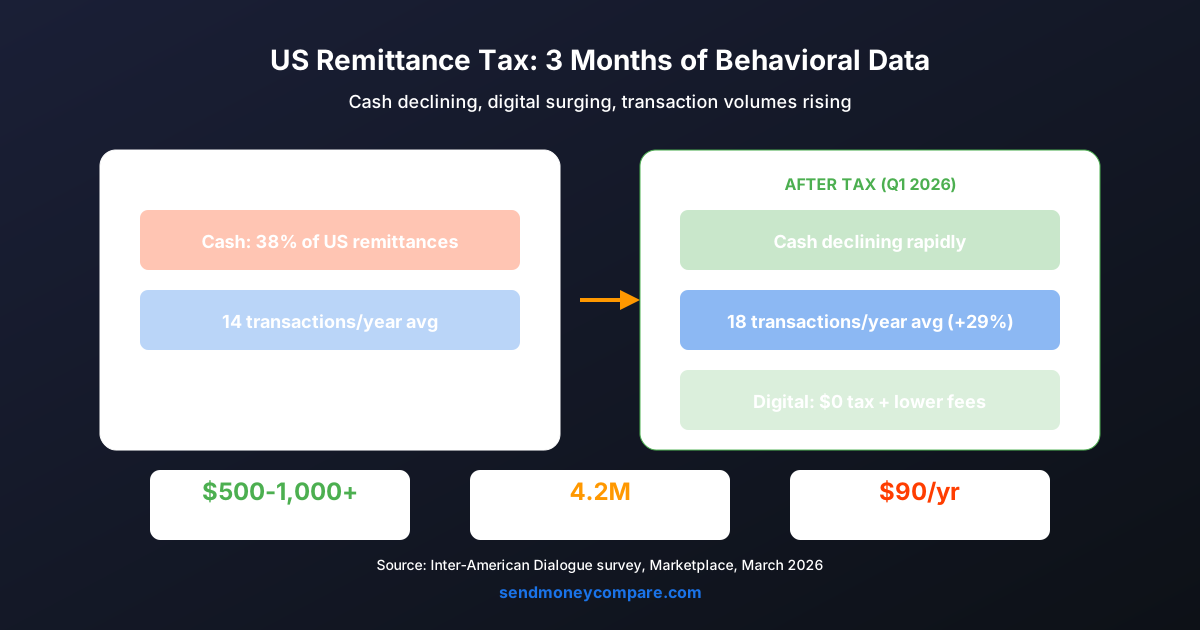
New survey data 3 months after the US excise tax: transactions rose from 14 to 18/year, cash is declining fast, and digital providers like Wise and Remitly are surging. Save $500-1,000/year by switching — here's how.
When the 1% federal excise tax on cash-funded international remittances took effect on January 1, 2026, the remittance industry braced for a painful adjustment period. Three months later, the data tells a more nuanced story — and a surprising one.
According to the Inter-American Dialogue, a survey of 200 migrants in February 2026 found that transaction frequency actually increased from 14 to 18 transactions per year. And Marketplace reported that while some senders switched from cash to digital to avoid the tax, others simply absorbed the cost — suggesting the tax is functioning less as a deterrent and more as a revenue tool that disproportionately taxes the unbanked.
Our take: the tax is accelerating an inevitable shift
We wrote in January that the remittance tax would act as an "accelerant for an already-underway shift from cash to digital." Three months of data confirms this — but with caveats that matter for everyday senders.
The good news: Revenue increased across almost all money-transmitting companies. More transactions, not fewer, are flowing through formal channels. Digital-first providers like Wise, Remitly, and WorldRemit — none of whose customers pay the tax — are seeing accelerated growth. Remitly reported 4.2 million active customers in Q4, up 48% year-over-year.
The bad news: The people who can least afford additional costs are the ones paying. Marketplace's analysis highlights that for many cash senders, the issue isn't awareness of digital alternatives — it's access. Unbanked immigrants who rely on cash may not have the bank account or debit card needed to fund a digital transfer. For them, the 1% tax isn't a nudge toward digital; it's simply an additional cost on an essential financial service.
The numbers in context
On a $500 transfer, the 1% tax adds $5. That's on top of typical cash transfer fees of $8–$15 and exchange rate markups of 3–5%. Over 18 annual transactions, a frequent cash sender pays roughly $90 in tax alone — or $270+ when you include the higher fees and worse rates that cash transfers carry compared to digital.
By contrast, sending the same $500 digitally through Wise costs around $5–$7 total with the mid-market exchange rate. Through Remitly, it's often $0 in fees with a small exchange rate markup. No tax. The annual savings from switching to digital: $500–$1,000+ depending on the corridor.
Provider-by-provider impact
Here's how the major providers are handling the tax three months in:
- Western Union — Most exposed. A significant share of WU's US volume still comes from in-person cash transactions at agent locations. The company has added tax disclosures at point of sale but hasn't absorbed the cost. Cash senders pay the 1% on top of existing fees.
- MoneyGram — Similar position to WU, though MoneyGram has been pushing its app-based transfers harder. The company told Border Report it has seen "meaningful migration" from cash to digital since January.
- Wise — Entirely unaffected. Wise is 100% digital with no cash funding option. None of its customers pay the tax. This is increasingly becoming a selling point in Wise's marketing.
- Remitly — Also unaffected, as all transfers are funded digitally. Remitly published a detailed guide explaining why its transfers are exempt — and saw 48% user growth in Q4.
- WorldRemit — Digital-only funding, so no tax applies. Cash pickup remains available as a delivery method (which is not taxed — the tax applies to how you fund the transfer, not how the recipient receives it).
Cash vs digital: the annual cost comparison
For a sender transferring $500 per month (18 times per year):
- Cash at agent: $8-15 fee + 3-5% FX markup ($15-25) + 1% tax ($5) = $28-45 per transfer / $504-810 per year
- Digital via Wise: $5-7 fee + 0.4% FX markup ($2) + $0 tax = $7-9 per transfer / $126-162 per year
- Digital via Remitly: $0-4 fee + 1-2% FX markup ($5-10) + $0 tax = $5-14 per transfer / $90-252 per year
Annual saving from switching cash to digital: $250–$720, depending on provider and corridor.
What this means for you
If you've already switched to digital transfers, you're on the right side of this trend. If you haven't, here's the case in one sentence: digital transfers are tax-free, cheaper, faster, and trackable.
For those who still need cash pickup at the receiving end, providers like Remitly and WorldRemit offer a hybrid model — you fund digitally (no tax) and your recipient collects cash locally. That's the best of both worlds.
Note: the IRS is providing penalty relief for providers through Q3 2026, giving the industry time to update systems. After that, enforcement tightens — another reason cash costs will only increase.
Use our comparison tool to see real-time costs across providers for your specific corridor. For a complete breakdown of which providers charge the tax and how to avoid it, see our US remittance tax guide. And for the broader picture of where costs are heading, our 2026 global remittance trends report covers the full landscape.
Frequently asked questions
How much is the US remittance tax?
The federal excise tax is 1% of the transfer amount, applied only to cash-funded international remittances. A $500 cash transfer incurs a $5 tax. Digital transfers funded by bank account, debit card, or credit card are exempt.
How do I avoid the 1% remittance tax?
Fund your transfer digitally instead of with cash. Use a bank account, debit card, or credit card through any provider's app or website. Providers like Wise, Remitly, and WorldRemit are 100% digital and entirely unaffected by the tax.
Which money transfer providers charge the remittance tax?
The tax applies at providers that accept cash funding — primarily Western Union and MoneyGram agent locations. Digital-only providers like Wise, Remitly, and WorldRemit don't charge it because their transfers are funded electronically.