Awais Imran
In this guide
Can You Use Stablecoins to Send Money Abroad?
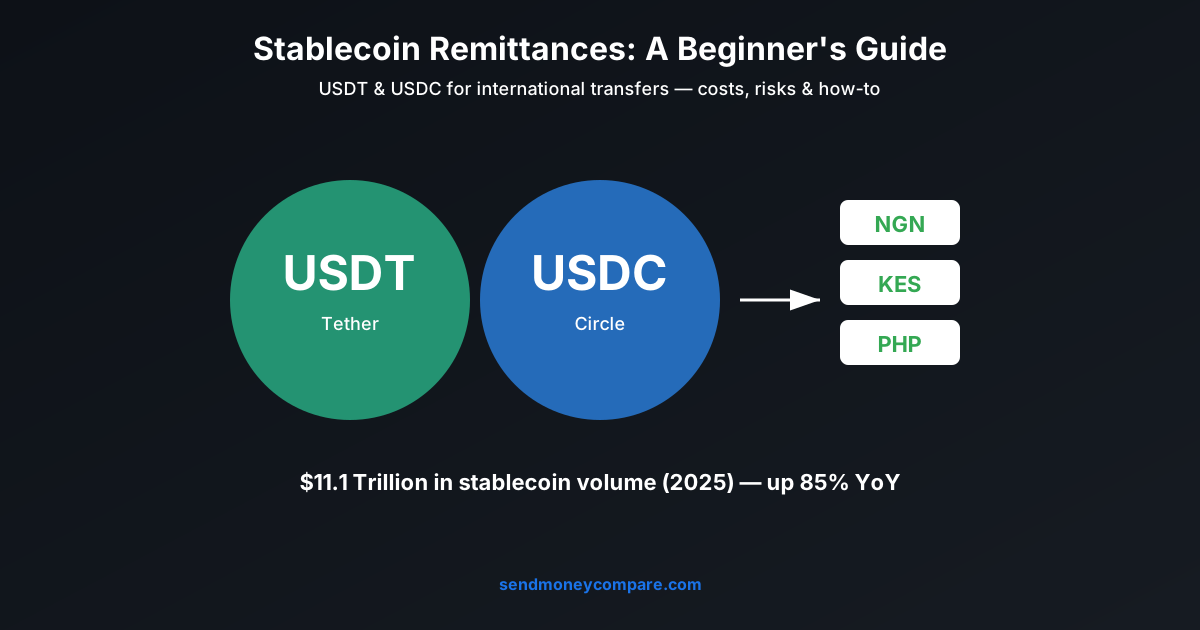
Quick answer: Yes — and a growing number of people are doing it. Stablecoin payment volume reached $11.1 trillion in 2025, up 85% year-over-year. For international transfers, stablecoins like USDT (Tether) and USDC (Circle) can move value across borders in minutes for under $1 in network fees. However, the real cost includes on-ramp and off-ramp fees (converting local currency to/from stablecoins), which can total 1–3%. For most people, specialist providers like Wise or Remitly remain cheaper and simpler. Stablecoins make sense for specific use cases — tech-savvy senders, unbanked recipients, or corridors with limited provider coverage.
The promise of stablecoins for remittances is straightforward: skip the banks, skip SWIFT, skip the middlemen. Convert your dollars to USDT, send it on the blockchain, and have your recipient convert it back to local currency. In theory, it's instant and nearly free.
In practice, it's more nuanced. Let's break down how it actually works, what it costs, and where it makes sense in 2026.
What Are Stablecoins and How Do They Work for Transfers?
Stablecoins are cryptocurrencies pegged to a stable asset — usually the US dollar. The two largest are:
- USDT (Tether) — Market cap ~$140B. The most widely used stablecoin globally, especially in emerging markets. Available on multiple blockchains (Tron, Ethereum, Solana).
- USDC (Circle) — Market cap ~$60B. Fully regulated, audited reserves. Favoured by institutions and increasingly used for cross-border B2B payments. Available on Ethereum, Solana, Base, and others.
A stablecoin international transfer works in three steps:
- On-ramp: Convert your local currency (USD, GBP, EUR) to USDT or USDC via an exchange (Coinbase, Binance, Kraken) or a peer-to-peer platform.
- Transfer: Send the stablecoins to your recipient's wallet address. This happens on-chain and typically settles in seconds to minutes.
- Off-ramp: Your recipient converts the stablecoins to their local currency via a local exchange, peer-to-peer marketplace, or mobile money agent.
The blockchain transfer itself is cheap — often under $0.01 on networks like Tron or Solana. The real costs are in steps 1 and 3.
Real Costs: Stablecoins vs Traditional Providers
Let's compare the total cost of sending $1,000 from the US to Nigeria using stablecoins versus traditional providers:
$1,000 USD → NGN: Stablecoin vs Traditional
*Coinbase offers free USDC purchases for US users. Off-ramp costs vary by country and platform. Traditional provider costs from our comparison engine.
For well-served corridors like US-to-India or UK-to-Philippines, traditional providers are usually cheaper and far simpler. Stablecoins become competitive for corridors where provider coverage is thin or fees are high — such as transfers to Sub-Saharan Africa, small Pacific Island nations, or between emerging markets.
Where Stablecoins Make Sense for Remittances
Stablecoins aren't a universal replacement for traditional transfer services. They work best in specific scenarios:
1. High-Cost Corridors
Sub-Saharan Africa remains the most expensive region to send money to, with average costs above 7% according to the World Bank. For corridors where traditional providers charge 5–8%, stablecoins at 1.5–3% total cost represent a genuine saving.
2. Unbanked or Underbanked Recipients
In countries like Nigeria, Kenya, and the Philippines, crypto adoption is high and peer-to-peer exchanges are well-established. Recipients can convert USDT to local currency via mobile money agents even without a bank account.
3. Speed-Critical Transfers
Stablecoin transfers settle in seconds on networks like Tron and Solana, compared to 1–3 business days for bank wires. Even Remitly's express service, while fast, still depends on the receiving country's banking infrastructure.
4. Large Business Payments
Cross-border B2B stablecoin payments are growing fastest of all, with companies using USDC to pay suppliers and contractors in emerging markets. For more on business transfers, see our international business payments guide.
Risks and Downsides to Know
Stablecoin remittances are not risk-free. Here's what to consider:
- Off-ramp availability: Converting stablecoins to local currency depends on local exchange infrastructure. In some countries, off-ramp options are limited, costly, or require in-person meetups.
- Regulatory uncertainty: Crypto regulation varies dramatically by country, and it keeps changing. Some nations (like China and India) have restricted crypto trading, making off-ramping difficult or risky. Brazil went a different direction, and it's moving fast. Since February 2026, its central bank has treated stablecoin transactions used for cross-border payments as foreign exchange operations under BCB Resolution 521, which brings them under the same 3.5% IOF tax that applies to a traditional wire — erasing most of the stablecoin cost advantage on that corridor without any change to the network fee itself. A follow-up rule, BCB Resolution 561, goes further: from 1 October 2026, licensed Brazilian FX providers are barred from using stablecoins or any other crypto asset to settle payments with counterparts abroad at all, closing off the regulated on-chain settlement route for cross-border payments into or out of Brazil rather than just taxing it. Confirm the current rules for your specific corridor before assuming a cost advantage holds — this is a fast-moving area. Our crypto banking licences 2026 piece covers the evolving regulatory landscape.
- No consumer protection: If you send USDT to the wrong wallet address, the money is gone. Traditional providers like Wise and Western Union offer refunds and dispute resolution. Blockchain transactions are irreversible.
- Technical complexity: Your recipient needs a crypto wallet, understands how to convert to local currency, and must manage private keys. This is a significant barrier for non-technical users.
- Counterparty risk: USDT (Tether) has faced ongoing questions about its reserve backing. USDC (Circle) is fully audited and regulated, making it the safer choice for larger amounts.
For a broader view on transfer safety, see our money transfer safety guide.
How to Send a Stablecoin Transfer: Step by Step
- Set up a crypto account — Register with Coinbase, Binance, or Kraken. Complete identity verification (KYC). This takes 10 minutes to a few days depending on the platform.
- Buy USDT or USDC — Fund your account via bank transfer or card, then purchase stablecoins. On Coinbase, USDC purchases are free for US users.
- Get your recipient's wallet address — Your recipient needs a compatible crypto wallet. Free options include Trust Wallet, MetaMask, or exchange wallets. Confirm the network (e.g., Tron TRC-20, Ethereum ERC-20) — sending to the wrong network can result in lost funds.
- Send the stablecoins — Enter the wallet address, amount, and confirm. On Tron, the transfer arrives in seconds for under $1. On Ethereum, gas fees can be $2–$10.
- Recipient converts to local currency — Using a local exchange (e.g., Luno in Africa, Binance P2P in Southeast Asia) or a peer-to-peer marketplace. Conversion rates and fees vary.
Important: Always send a small test amount first. Double-check the wallet address and network. There's no undo button on blockchain.
The Verdict: Stablecoins vs Traditional Providers
For most people sending money to well-served corridors (US/UK/EU to India, Philippines, Mexico, Pakistan), traditional providers like Wise, Remitly, and Instarem remain the better choice — they're cheaper, simpler, and offer consumer protections.
Stablecoins are worth considering if you're:
- Sending to a high-cost corridor where traditional providers charge 5%+
- Transferring to an unbanked recipient who has crypto access
- Making large B2B payments where the on/off-ramp costs are proportionally small
- Comfortable managing crypto wallets and blockchain transactions
The trend is clear: stablecoin remittances will grow significantly over the next few years as on/off-ramp infrastructure improves. But for now, they're a complement to traditional services, not a replacement. Compare your options using our comparison tool — and if a traditional provider is cheaper for your corridor, stick with it.
Sending money with stablecoins: sources and method
Stablecoin volume data from Circle's 2025 annual report and Chainalysis 2026 Crypto Geography Report. Remittance cost averages from World Bank Remittance Prices Worldwide. Traditional provider costs from our automated quote collection system.
Sending money with stablecoins: questions answered
Is it cheaper to send money abroad with stablecoins or Wise?
Can I send USDT to someone without a bank account?
Which stablecoin is safest for international transfers?
What are the risks of using stablecoins for remittances?
About the author